University of Richmond alum leads public K-8 language-immersion school
The halls reverberated with the fast, rhythmic booming of taiko drums. Students dressed in Samurai armor and colorful kimonos greeted visitors. Adults and children alike tried their hands at calligraphy and origami and danced to a traditional sea shanty. The South Academy of International Languages (SAIL) was celebrating its annual Japanese Culture Night last April, and principal David Lynn was in his element.
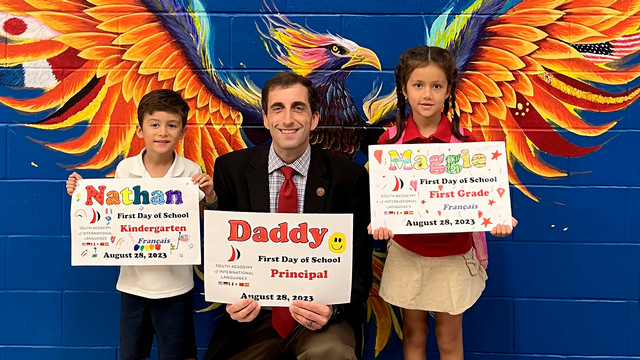
Since July 2023, Lynn, a 2000 graduate of the University of Richmond, has led the Charlotte, North Carolina, K-8 magnet public school, which teaches the state’s full curriculum through language immersion. SAIL’s 1,252 students represent diverse socio-economic, racial, and cultural backgrounds. Parents of entering kindergarteners choose the language — French, German, Japanese, or Mandarin Chinese — through which their children will receive instruction in all their core subjects throughout elementary school. In middle school, students can opt to study Spanish as well.
“We prioritize the importance of understanding language learning and how people interact globally,” the principal said. “The only time our students hear English is during English class and electives like art and PE. Beginning in fifth grade, students participate in exchanges with partner schools in China, France, Germany, and Japan. We strive to foster curiosity, empathy, and a desire to learn from each other about our differences.”
What drew him to the school, first as a parent and later as principal, was its culture, Lynn said.
“You get the most authentic sense for a school’s culture by observing the cafeteria and recess,” he said. “Where students choose to sit in the cafeteria. What friend groups form on the playground. When our students embrace those who are different in some way, a lot of learning happens.”
Lynn, who speaks a little Chinese and French, said he is not qualified to teach any of the languages taught at SAIL and can barely match the language skills of a SAIL first grader.
Instead, he said, “A primary part of my job is to support the highly qualified teachers and staff, who share in the leadership of our school. I fuel the fire and then get out of the way so teachers can do what they do well, ensuring the school community flows in concert.”
During his first semester at Richmond, an introductory education course exposed him to local schools and inspired him to consider teaching. His leadership studies and history majors and education minor broadened his understanding of what it means to be globally aware and engaged in one’s community, the alum said.
Just prior to graduation, an unexpected opportunity changed the course of Lynn’s life. An alum friend asked him to post flyers around campus advertising an English-teaching position in the remote Hungarian farming commune of Kétsoprony.
“My initial thought was, why would anyone do this?” he said. “But the next thing I knew, I was on a plane heading to Hungary to teach English. Suddenly, I’m living in a small apartment attached to the village school. Garbage was collected by horse-drawn carriage and the night sky was lit up with stars. The eagerness of the students and sense of community blew my mind!”
That first experience abroad led to a year teaching in Linyi, China, followed by two years at a Massachusetts boarding school and eight years at the American School of Paris. He later moved to Charlotte to serve as director of international studies at the private Charlotte Country Day School.
Along the way, Lynn earned a Master of Education in School Leadership from Harvard University and a Ph.D. from the University of North Carolina at Charlotte. He and his wife Ming Qi, an emergency physician, are raising four globally minded children and have welcomed multiple international exchange students into their home.
He remains connected to Richmond by sharing his career insights during the EDGE Institute, the Jepson School of Leadership Studies’ annual professional-development program for juniors.
“There’s a rich connection between the leadership studies degree and education,” Lynn said. “Jepson provides you with lenses through which to interpret how others lead. You can utilize that insight to inform how you lead in your own context.”