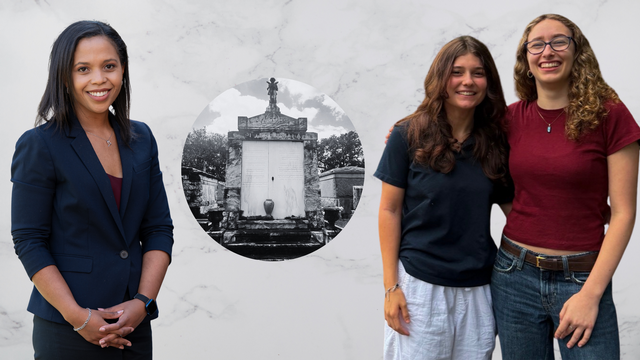
Murder most foul: University of Richmond professor and students research a kidnapping-turned-murder
In the summer of 1907, Italian immigrants lured eight-year-old Walter T. Lamana from his home in New Orleans’ French Quarter with promises of sweets. A few days later, the boy’s father, Peter Lamana, a prosperous Italian funeral director, received a $6,000 ransom note. A two-week search led to the discovery of Walter’s mutilated body in a swamp 10 miles away. The kidnapping-turned-murder was attributed to the Black Hand, the name given to Italian extortionist rings operating in the United States in the early 1900s. It provoked public outrage, threats of vigilante justice, and a media frenzy. Ultimately, the case landed in the Louisiana Supreme Court.
Some 119 years later, Dr. Lauren Henley, assistant professor of leadership studies, and sophomores Sophie Atiyeh and Madeleine Roncka have been conducting exhaustive archival research on the case. Henley is a historian whose research focuses on violent crime in the South and West in the late 19th and early 20th centuries.
“This research project is a study of power contestations on multiple fronts, as seen through the lens of a captivating, horrific crime,” Henley said. “Madeleine is interested in how media creates and reinforces biases, Sophie in what crimes rise to national prominence. With their help, my goal for the summer is to gather and transcribe 3,000 articles on the case.
“When we can use AI to transcribe articles, the process is 10 times more efficient. But we must check the AI transcriptions against the originals for accuracy. AI makes mistakes and sometimes ghostwrites a sentence.”
The transcribed articles will comprise an extensive data set that Henley can query when she moves to the writing and analysis phase of the project.
“Sophie and I came to campus on June 2 to get a crash course on research skills,” said Roncka, who plans to major in leadership studies. “Dr. Henley showed us how to use the bibliographic software program Zotero and databases like Ancestry.com, Newspapers.com, and FamilySearch.org.”
Although they conducted most of their research remotely, the students traveled to Louisiana with Henley in late June, supported by funding from the School of Arts and Sciences. They visited key sites related to the crime, including Walter Lamana’s tomb, and walked the kidnapping route in the French Quarter. They also conducted research at the Archdiocese of New Orleans and at the Louisiana State Archives in Baton Rouge.
“At the Louisiana State Archives, we found a death warrant dated June 1909 for Leonardo Gebbia, one of the six conspirators convicted of the crime,” said Atiyeh, who plans to major in leadership studies and political science.
This find pointed to the inequitable administration of justice. A public outcry erupted following the trial of the first four conspirators, who received life, a sentence that usually translated to 10-15 years in the early 20th century. At the later trial of Leonardo Gebbia and his sister, Nicolina, the court ruled more harshly, handing down two death sentences.
Leonardo hanged. But because executing women was frowned upon at the time, Nicolina’s sentence was commuted to life in prison. She was eventually pardoned by the governor.
“Questions of state-sanctioned punishment reveal how justice was negotiated as not simply the outcome of a criminal act, but the context in which it occurred, the individuals involved, and public sentiment surrounding the case,” Henley said.
For Atiyeh and Roncka, working on Henley’s project served as an introduction to academic research.
“It was interesting to see how different newspapers described the Italian community,” Roncka said. “The Picayune seemed to show some prejudice against Italians, but The Times-Democrat presented a more neutral view.”
“The most rewarding part of the experience was learning research skills and working with Dr. Henley to see how she researches a subject,” Atiyeh added.