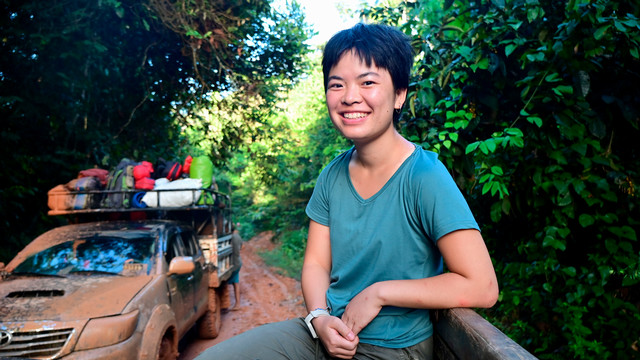
Jungle journey: An internship takes University of Richmond senior into the heart of the Amazon
As a member of the University of Richmond’s Amazon Borderlands Spatial Analysis Team (ABSAT), Jasmine Lin has spent the last two years conducting spatial analyses of the impact of roadbuilding on deforestation in the Amazon, the world’s largest rainforest. This summer, the leadership studies and geography major saw those impacts firsthand during her internship as a cartographer with the Upper Amazon Conservancy, a nonprofit dedicated to protecting the forests and Indigenous peoples of the Upper Amazon.
“It was conceptually crazy for me,” said the senior from Guangzhou, China. “I was in the part of the Amazon that ABSAT has been mapping for years. I personally had put the labels on rivers on countless maps — and suddenly I’m there, navigating those rivers!”
During the first few weeks of June, Lin traveled by road through Peru with Dr. David Salisbury, associate professor of geography, environment, and sustainability and co-director of ABSAT, and a group of Indigenous Brazilians and Peruvians. They were headed for Selva Central, Peru’s lush, subtropical rainforest in the foothills of the Andes, where they would visit sites sacred to Indigenous communities. The senior collected GPS coordinates on the towns, communities, and sites they visited, data she would later use to map their journey.
The roads they traveled traversed fields where rainforests had once stood, but which now were cultivated with cacao, oranges, and plantains. They also passed by many secondary forests, which had grown up after the original rainforests were cleared.
“The secondary forests are sparser, with shorter trees and not much wildlife,” Lin explained. “We didn’t hear birds or see animal tracks. The Indigenous people talked about how communities connected to roads have lost their culture, language, and traditions as well as the wildlife that once was important to them. They used to depend on the forest for their food, but in urban areas, they now pay for food, which feels strange and uncomfortable for them.”
The second part of the group’s journey began in mid-June when the road ended near the border of Peru and Brazil. Lin and her fellow travelers climbed into motorized canoes piloted by Indigenous guides. They navigated the rivers and streams to the headwaters — sometimes disembarking to drag the canoes through ankle-deep stretches of water — moving ever deeper into the rainforest.
“We passed primary forests with vines dangling from giant trees,” said the intern. “We saw kingfishers, herons, and many other birds. At night, we pitched our tents under the thatched roofs of the open-air houses in the Indigenous communities along the riverbanks. There were so many stars!”
After several weeks of traveling, the group reached an Asháninka community celebrating the 34th anniversary of the legal titling of their land by the Brazilian government. “Some people played drums and panpipe-type instruments made from bamboo cane,” Lin said. “Others shook wreath-shaped instruments strung with seed shells. People danced and chanted to the rhythmic music. They ate yuca, beef, and fish and drank masato, an alcoholic drink made from fermented yuca.”
By late June, the senior was back in the Upper Amazon Conservancy office in Pucallpa, Peru, using the GPS coordinates she collected on her journey to create a map to share with the Indigenous people who had traveled with her.
“The Upper Amazon Conservancy uses GPS to map invasive logging and forest fires, help Indigenous communities get titles to their land, and even install Internet in remote areas,” Lin said. “Working for the conservancy has been a dream! My co-workers tell me about the complexities of the issues, which I don’t get from reading scholarly articles and looking at maps.”
The Jepson School of Leadership Studies awarded Lin a Burrus Fellowship, part of the Richmond Guarantee program, to support her credit-bearing internship with the Upper Amazon Conservancy. Dr. Salisbury, who serves on the nonprofit's board, connected her to the internship opportunity.
This fall, Lin plans to undertake an independent study with Dr. Christopher Von Rueden, an anthropologist and professor of leadership studies who has conducted ethnographic fieldwork with Tsimané forager-horticulturalists of the Bolivian Amazon.
“I hope to learn more about Indigenous leadership, social structure, and egalitarianism during my independent study,” she said. “After college, I want to attend graduate school to continue to study issues related to the environment and peoples of the Amazon. Eventually, I’d love to work for a conservation nonprofit.”