University of Richmond senior receives scholarship to Oxford master’s program
Daniel Polonia’s joyful enthusiasm for making the world a better place is palpable. The first-generation college senior learned about social injustice in the United States in his University of Richmond classes and about human rights abuses in a study-abroad program that took him to Nepal, Jordan, and Chile.
Last year, he concluded he could best address some of these issues through a career in academia. His recent selection as a Jepson Scholar provides him with a pathway to achieve that goal by awarding him an all-expenses-paid scholarship to a master’s program in higher education at the University of Oxford.
“In my Richmond classes, we talked a lot about how we can fix systemic inequalities to create a better future,” said the leadership studies and rhetoric and communication studies major. “I decided the best way to change minds is to work in higher education where the mission is to center the common good and search for new truths.”
During the past three semesters, he studied the challenges currently buffeting higher education.
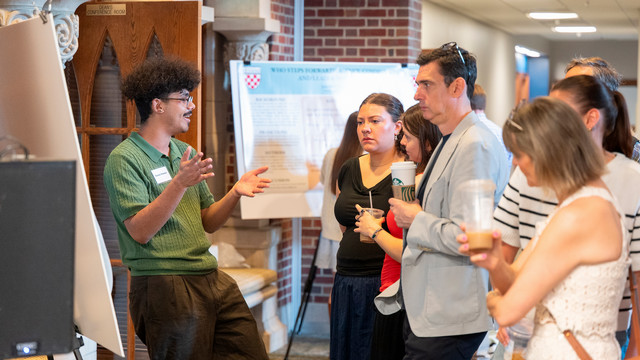
At the Jepson School of Leadership Studies Research Symposium in April, Polonia presented an independent study he undertook. Dr. Crystal Hoyt, professor of leadership studies and psychology, served as his faculty advisor. The idea for his research emerged when a friend asked if he’d noticed that the value the public places in higher education began to decrease at the same time more women were entering academia. He devised a study to test a possible cause-and-effect correlation.
“I looked at labor market research, specifically the pollution theory, which holds that when women enter a field, the wages decrease,” he said. “Was higher ed experiencing a similar devaluation with the increase in female students and faculty?”
To test this hypothesis, Polonia devised a study that featured mission statements and vignettes about two hypothetical universities. One emphasized independent values often associated with men, such as competition and personal agency. The other emphasized interdependent values often associated with women, such as collaboration and coalition building.
“Three hundred people responded to the online survey,” the senior said. “Contrary to what we predicted, respondents rated both hypothetical universities highly in terms of interest and prestige.”
Last fall, Polonia used Gallup poll data to conduct a philosophical analysis of growing public distrust in higher education for his Leadership Ethics class. He used a rhetorical lens to analyze the same data for his Rhetoric and Law class.
This past semester, he took Leadership and the Future of Higher Education with Dr. Ronald Crutcher, university professor and president emeritus. “We discussed how a university president must curate messages for many people who hold different views,” Polonia said. “We also read Peril and Promise: College Leadership in Turbulent Times. The book laid out an ABCs framework for creating inclusive environments on college campuses: affirming identity, building community, and cultivating leadership.”
Polonia has some firsthand experience with these ABCs. For the past three years, he served as a head resident for Gray Court, a co-ed sophomore residence hall. “I’m a queer Latino guy who was in charge of a staff of nine resident assistants,” he said. “Making community was a big part of my job. Listening, transparency, and communication are critical.”
His efforts did not go unnoticed. The Association of College and University Housing Officers International recently presented him with an award for his residence life programming.
Now Polonia is looking beyond his graduation from Richmond to his matriculation at Oxford this fall. “I want to work in a university, possibly as a professor of rhetoric and communication studies or as an administrator in an office of inclusion and belonging,” he said.