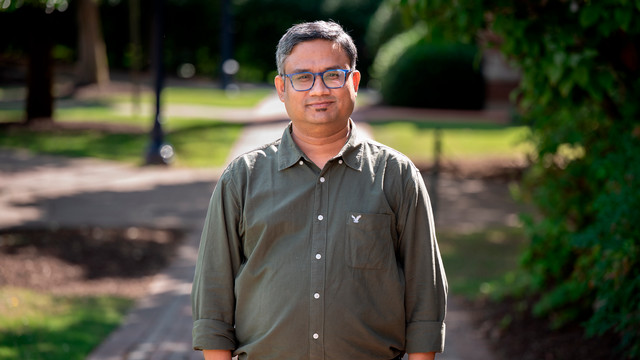
Q&A with Dr. Kazi Huda, a visiting international scholar at the University of Richmond
Dr. Kazi A S M Nurul Huda is the 2025–27 Zuzana Simoniova Cmelikova Visiting International Scholar in Leadership and Ethics at the Jepson School of Leadership Studies. A native of Bangladesh and associate professor of philosophy at the University of Dhaka, he brings an international perspective to the study of leadership ethics. His current research focuses on the ethics of open-mindedness in political leadership in polarized societies. This semester, he is teaching a section of the Historical Foundations of Leadership (LDST 101).
How would you describe the ethics of open-mindedness in political leadership?
Philosophers describe open-mindedness as an intellectual virtue, a way to be a better thinker, a way to understand difficult or unfamiliar topics. Practitioners of open-mindedness have the ability and willingness to transcend their existing views and seriously consider alternative views. Open-mindedness is a character trait that can be developed over time through self-examination and the intentional consideration of perspectives that may not be easily accessible. When used by political leaders, it helps reduce polarization and establish peace within and between countries.
Who are a few philosophers who have influenced your thinking?
Twentieth-century Irish philosopher Iris Murdoch made the radical claim that morality is not about choice but about how we view the world: “I can only choose within the world I can see.” Therefore, she argued, to improve morally, we must retrain ourselves to see different perspectives. Recently, I have studied the 19th-century Bengali mystic philosopher Fakir Lalon Shah. He criticized the caste system of Bengal [modern-day Bangladesh and the Indian province of West Bengal], arguing that people should be viewed as individuals, not as compilations of caste, religion, and social identifiers. He expressed this philosophy through song and promoted practices of self-reflection.
Does the study of philosophy differ in Bangladesh and the U.S.?
At the University of Dhaka, we practice philosophy horizontally. At U.S. universities, it is practiced vertically. By that I mean that, in Bangladesh, academics learn a little bit about all kinds of philosophy. But in the U.S., academics must be experts in one or two, at most three, areas of philosophy. Also, in the U.S., philosophy is largely confined to the academy. In Bangladesh, people meet in nonacademic groups as well to read, study, and discuss philosophy.
How would you describe your teaching style?
I’m a pro-student teacher who focuses more on learning than on grades. Typically, my classes are interactive, so having a class of only 11 students at the University of Richmond is a dream come true for me. I persuade students to read the material before coming to class and then call on them to discuss it. For example, this semester we read Sultana’s Dream, a utopian novel by the Bengali feminist Begum Rokeya. It depicts an imaginary world where women do all the things men have done traditionally and men are kept locked in the house doing women’s work. Then I have the students try on reverse identity. If you are white, imagine being Black. If you are rich, imagine being poor. Leaders should be empathetic and this kind of exercise builds empathy.
What do you think of your experience at the University of Richmond so far?
It’s fascinating. The faculty are friendly, the staff keep things running smoothly, and the campus is beautiful, especially in the spring and fall. In Bangladesh, I teach three classes of about 150 students each per semester, which leaves little time for research. I am grateful to the Jepson School for giving me the time and structure to carry out my research. And I particularly enjoy leading a class where I know every student’s name, as it is essential for teaching students as individuals!