Robust research defines University of Richmond student’s undergraduate experience
Samuel Chanenson exemplifies the contributions undergraduates can make by creating new knowledge through original research. The senior leadership studies and psychology major has been conducting research for three years. He said he chose the University of Richmond because it offers students abundant research opportunities.
“Richmond is a unique institution in that it has resources akin to an R1 [top-tier research] university and the student-faculty ratio of a small liberal arts college,” he said. "I knew I would be able to get a robust research experience here.”
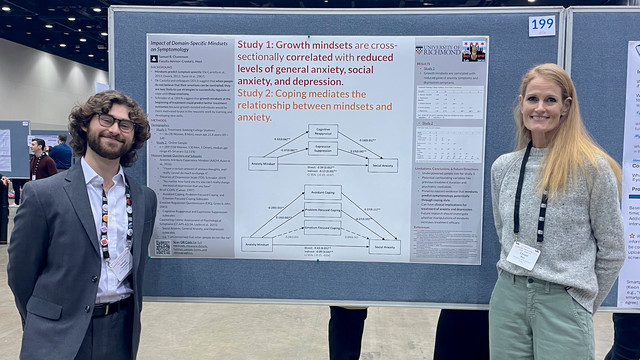
In February, he presented his psychology senior honors thesis research at the Society for Personality and Social Psychology Convention in Chicago. He will present it again on April 17 at on-campus student research symposia hosted by the Jepson School of Leadership Studies and the School of Arts and Sciences.
“My thesis examines the relationship between mindsets and symptoms of depression and anxiety,” he said. “Specifically, it investigates whether coping style can mediate this relationship. It finds that a growth mindset — the belief that a person’s attributes and abilities can be improved — correlates with reduced symptoms for general anxiety, social anxiety, and depression.”
Leadership studies and psychology professor Crystal Hoyt, an expert on growth mindsets, serves as his faculty advisor on the project and is working with him to publish his thesis.
“I have never encountered an undergraduate researcher more motivated, independent, and hard-working than Sam,” Hoyt said. “Alongside his academic acumen, he brings a deep commitment to social justice and a rare ability to connect rigorous scholarship to the urgent, real-world questions that shape equity, inclusion, and the world around us.”
For his thesis, Chanenson said he analyzed a relatively small sample of treatment-seeking college students and a larger online sample. To get the former, he partnered with Dr. Kristen Day, the University’s director of Counseling and Psychological Services, to collect survey data from 49 de-identified Richmond students.
“I learned a lot about clinical treatment at colleges and how to embrace the messiness of data collection,” the senior said. The psychology department offered him the John Neasmith Dickinson Memorial Research Award to support his thesis research.
Chanenson’s thesis research builds upon his already impressive research record at Richmond. He worked in Dr. Arryn Robbins’ visual cognition lab during the first semester of his sophomore year. The next semester, he began working with Dr. Laura Knouse on research into how spontaneous thoughts affect procrastination in college students who experience attention deficit hyperactivity disorder.
This past summer, Chanenson completed his credit-bearing Jepson School internship as a research assistant at Utah State University in the Acceptance and Commitment Therapy Lab, which studies obsessive compulsive disorder (OCD) therapy. His internship at an R1 research university convinced him he was capable of conducting high-level research.
“I worked with six Ph.D. students, co-authored two papers for peer-reviewed publications, and learned to conduct semi-structured diagnostic interviews,” he said. “We were looking at how to adapt a certain type of OCD therapy to an online platform, making it accessible to a larger audience. It’s a great example of how to apply novel digital technologies to support better health outcomes.”
Following his Richmond graduation, Chanenson will pursue a Master of Science in applied digital health at the University of Oxford on an all-expenses-paid scholarship as a Jepson Scholar.
“I’m passionate about how to make clinical care effective,” he said. “I want to match my interests and the critical thinking skills I developed in my leadership studies and psychology classes to meet novel digital health challenges.”