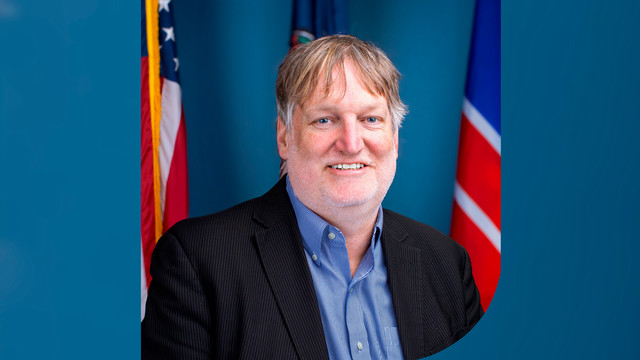
University of Richmond professor studies and practices leadership
Some people are scholars of leadership. Some are practitioners of leadership. Dr. Thad Williamson is both. He currently teaches two classes a semester as a professor of leadership studies and philosophy, politics, economics, and law at the University of Richmond. He also works part-time as a senior policy strategist for Mayor Danny Avula in the Richmond Mayor’s Office.
“Through my work with previous administrations, I gained an appreciation for how the city of Richmond organization functions, how to make things happen, and how to build success,” said Williamson, who worked for Avula’s immediate predecessors, Mayors Levar Stoney and Dwight Jones. “I became convinced that city operations need to modernize for the city to achieve its goals. Mayor Avula focuses on this.”
The professor worked on Avula’s 2024 mayoral campaign, led a 40-person team as the administration’s transition director after the election, and helped formulate many of the mayor’s policy statements. As the senior policy strategist, he now plays an integral role in developing, implementing, and communicating the mayor’s policy agenda to the public and to city agencies.
Williamson helped craft the seven pillars of the “Mayoral Action Plan,” or MAP. The first six pillars focus on thriving in key areas: city hall, neighborhoods, families, the economy, inclusive communities, and the built environment. The seventh outlines goals for the city to tell its stories, including the truth about its history of slavery, racism, and struggles for Black empowerment.
“It was important to align the pillars with promises made to voters,” the policy strategist said. “As a representative of the people, the mayor is responsible for reshaping the city to meet what people want. To achieve that, we must connect the mayor’s vision with the people who do the work, get everyone on the same page, and establish accountability. We are collecting baseline data for every item in the plan. The data should drive innovation.”
Avula praised Williamson for his work on developing the MAP, crafting strategy for public housing redevelopment, redefining the outcomes of the Office of Community Wealth Building, and helping identify areas of deferred maintenance in Richmond’s critical infrastructure.
“Thad has been an invaluable part of our team,” the mayor said. “His knowledge of Richmond’s history, the intricacies of the city’s charter, and political science and strategy have helped drive significant pieces of our agenda.”
Williamson’s first stint in city government was from June 2014 – May 2016 when he took a leave of absence from the University of Richmond to serve as the inaugural director of the Office of Community Wealth Building. Then-Mayor Dwight Jones established the office to combat the city’s high poverty rate. Williamson subsequently served as transition director for then-Mayor-elect Levar Stoney and then part-time as a senior policy advisor to Stoney.
Describing his entrée into municipal government as more serendipitous than intentional, the professor said the experience nevertheless has made him a better scholar and teacher of leadership. He pointed to his 2024 book, The Making of Twenty-First-Century Richmond, which he co-authored with University of Richmond colleagues Julian Hayter, professor of leadership studies, and Amy Howard, associate provost for strategic initiatives and community engagement.
“It’s a different book than it would have been if I had not worked on the inside,” the lead author said. “My work in city governance also gives me concrete examples to use in class. I’ve become even more interested in leadership, because I see it firsthand — the human element, the interpersonal dynamics, the strategies people employ to advance their goals.”
He assigns students in his Justice and Civil Society class to volunteer in Richmond Public Schools. Jack Raiz, ’27, one of Williamson’s students who is volunteering in a fifth-grade class this semester, described his experience: “I work one-on-one with a student who struggles to stay engaged but clearly has so much potential. It brings our Justice and Civil Society class discussions to life and makes Richmond feel less like a case study and more like a community I'm now genuinely invested in."
Williamson’s own investment in the city of Richmond is paying dividends.
“Thad’s work here is literally creating a better future for our city,” Avula said. “I’m incredibly grateful for his service."