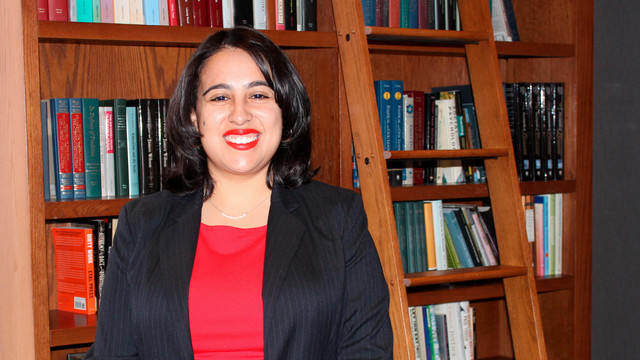
University of Richmond senior researches policies on disability and asexuality
The Centers for Disease Control and Prevention reports that more than one in four, or over 70 million, adults in the United States have a disability. The number of Americans who identify as asexual is significantly smaller, comprising only one percent of the population, according to the Asexual Visibility and Education Network. In her Jepson School of Leadership Studies honors thesis, senior Isabella Sabogal creates a theory at the intersection of these two communities and considers implications for U.S. policy.
Sabogal, a leadership studies and political science major and gender and sexuality studies minor, is quick to point out that the disability and asexual communities are distinct from each other.
“For a long time, we assumed that people with disabilities were asexual and people who were asexual were disabled,” she said, adding that such assumptions are generally not true. “Today we view asexuality as a sexual orientation rather than a medical disorder. It’s an identity that deserves the same anti-discrimination policies as those afforded gays and lesbians.”
But although she acknowledges the separateness of the disability and asexual communities, Sabogal said she is interested in finding ways to bring them together to work on advocacy. “In my thesis conclusion, I use language to help these communities see their similarities, to find common ground,” she said. “Both communities are advocating for similar things — access to rights and a validation of their human status.”
Her thesis, supervised by leadership studies professor Kristin Bezio, also considers the small segment of the population that identifies as having a disability while also being asexual. “Where do they fit in?” the senior asked. “I’m creating a theory for people with both these identities.”
She said she first became interested in disability advocacy while taking Rise of the Crips, a first-year seminar taught by Dr. Cort Schneider. Long used as a pejorative term to refer to people with disabilities, crips has been reclaimed by the disability community as a term of empowerment, Sabogal explained. She learned about asexuality during her sophomore year when she read journalist Angela Chen’s book Ace: What Asexuality Reveals About Desire, Society, and the Meaning of Sex.
As a humanities fellow supervised by Dr. Schneider during her sophomore and junior years, she undertook a self-designed research project focused on redefining intimacy through a disabled and asexual lens. She further deepened her knowledge of disability and sexual orientation as a member and current president of will, the University of Richmond program for students interested in exploring gender and social justice issues.
Last summer, Sabogal completed her credit-bearing Jepson internship with He She Ze and We, a Richmond-based nonprofit that supports transgender and nonbinary people. The internship helped her understand how to be an ally, she said. She extrapolated the ally and advocacy lessons to her thesis, where she makes specific policy recommendations that support the disability and asexual communities.
“I want to see accessibility policies implemented so that we think about how we construct spaces, such as adding slopes to sidewalks and ramps and elevators to buildings,” she said. “We should incorporate asexuality into sex ed and let people know it is okay not to want to have sex.”
The senior encourages individuals to embrace all parts of their identity. She identifies as a Latina woman who has a disability of her own: a speech impediment she overcame after years of speech therapy.
“Having a speech impediment may have subconsciously factored into my decision to pursue disability research,” she said. “My research has helped me develop empathy for myself and others. It’s okay to be unapologetically yourself — it’s part of the human experience.”