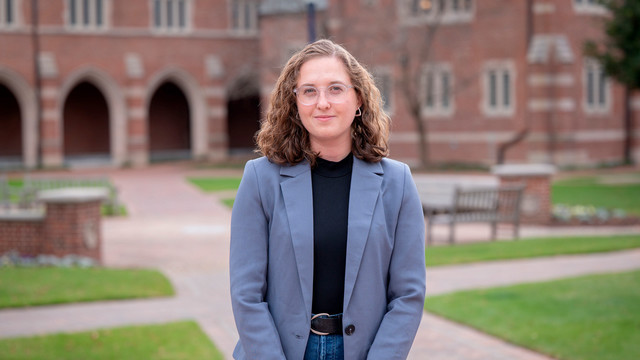
University of Richmond senior explores her Jewish-American identity
Kate Chasin came to the University of Richmond in fall 2022 eager to explore her Jewish identity. That exploration took on increased urgency in the wake of the Oct. 7, 2023, Hamas attack on Israel and the ensuing war in Gaza, which thrust Jewish-American issues into the political spotlight. Now a senior, Chasin is writing her Jepson School of Leadership Studies honors thesis on how the 2024 U.S. presidential candidates talked about Jewish issues.
“I am particularly interested in how the candidates talked about the Israel-Hamas war and the rise in antisemitism in the U.S.,” said Chasin, who identifies as a Reform Jew. “Candidates shift the way they talk about issues depending on their audience. How did the 2024 candidates talk about my community when we were not in the room?”
Political rhetoric often belies a complicated, muddied reality.
“Donald Trump has a core Christian white nationalist base,” Chasin said, “yet he says he is a strong advocate for Israel and against antisemitism. But his actions don’t always match his words. Stripping funding from higher education institutions to ensure his policy agenda is not the way to combat antisemitism. Anti-immigration and anti-pluralism stances are contrary to Jewish values.”
The Democratic Party was more critical of Israel than the Republican Party throughout the war in Gaza, including during the 2024 presidential campaign. Yet Chasin said that criticism of Israel should not be conflated with antisemitism. She also pointed out that Kamala Harris’ Jewish husband, Douglas Emhoff, was a vocal critic of antisemitism during Harris' vice presidency.
She noted an increase in Jewish viewers of Fox News since late 2023, likely due to the politically conservative channel’s pro-Israel coverage. Nevertheless, Harvard University’s Cooperative Election Study, an Associated Press/Fox analysis of online polling, and a GBAO Strategies survey respectively estimated that between 63, 66, and 71 percent of American Jews voted for Harris in the 2024 election.
In framing her honors thesis, Chasin draws on her leadership studies and philosophy, politics, economics, and law (PPEL) majors and Jewish studies minor. Leadership studies professor Bo Yun Park is her faculty mentor for her honors thesis. Park also is her mentor on collaborative research Chasin is conducting with fellow leadership studies senior Jack DeKorte on the use of generative AI in the 2024 presidential and congressional elections.
A remote internship with the New York City-based Shalom Hartman Institute has augmented her thesis research. “The institute is one of the world’s leading Jewish think tanks,” said the San Diego native. “My knowledge of American Jews has grown immensely since I started working there in August 2024.”
She credited Rabbi Josh Jeffreys, Richmond’s Jewish chaplain and director of religious life, with connecting her to the institute and considers him a mentor in her exploration of Jewish-American identity. She is active in the Chaplaincy’s Jewish Life Program, coordinating the weekly observance of Shabbat, the Jewish Sabbath. Following the Oct. 7 Hamas attack, she served as a Jewish student ambassador in meetings with the University administration.
Looking ahead, Chasin said she plans to earn a master’s in public policy and eventually work on political issues important to Jewish voters.
“I’m fascinated by Jewish-American politics,” she said. “Intellectualism and care for your community and the world are core pillars of Jewish identity. The desire to make the world a better place often leads to politics.”