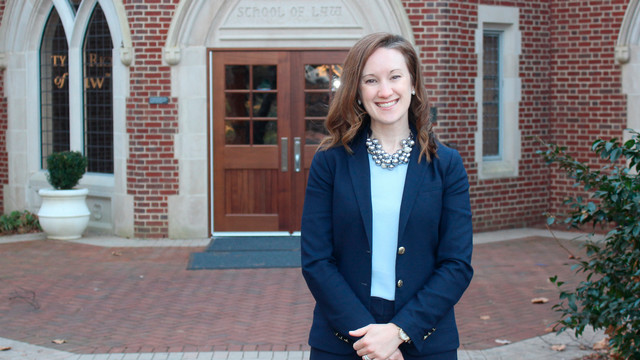
University of Richmond alum receives Gang Prosecutor of the Year Award
Gunfire erupted in Richmond’s Gilpin Court public housing community the evening of Sept. 12, 2022, claiming the life of 15-year-old Tynashia Humphrey, the innocent victim of a gang-related drive-by shooting. Between September 2022 and September 2025, Katherine Groover, assistant commonwealth’s attorney in the Richmond Commonwealth’s Attorney’s Office, successfully prosecuted all five defendants in the case, resulting in sentences totaling over 200 years.
Last month, the Virginia Gang Investigators Association recognized her herculean efforts by bestowing its 2025 Gang Prosecutor of the Year Award on the two-time Spider alum, a 2010 graduate of the Jepson School of Leadership Studies and a 2015 graduate of the Richmond School of Law.
Groover, who was emotional when discussing Humphrey’s murder, said the case has been the most complicated and challenging of her legal career.
“Tynashia and her two teenage nieces were walking from the store to their home when two cars carrying Henrico County gang members drove into Gilpin Court,” she said. “When the masked men spotted their intended victim’s car, they opened fire. Caught in the crossfire, the three young girls started running. A bullet struck Tynashia in her back and tore through her body. We knew we had to do something.”
For Groover, that something became a determination to do everything possible to advocate for the victim and her family and hold the perpetrators accountable. But it would not be easy.
No one could identify the masked perpetrators who had fired through partially lowered car windows. Humphrey’s nieces could give only a general description of the two cars. But that was enough to identify the cars based on surveillance video taken by cameras in the area. This evidence ultimately led Richmond and Henrico detectives to the five suspects, all members of 30 Boys, a homegrown Henrico County gang.
Investigators used this and other compelling circumstantial evidence to implicate the five gang members. Now it was up to Groover to convict them.
“In a 14-day period, our team handled more than a dozen pretrial motions filed by the defense attorneys,” Groover said. “The court ruled against us on several important motions, excluding some of our key evidence from trial, including evidence placing the defendants’ cellphones in the area at the time of the shooting. I was on my way to court when I learned that the judge also had ruled to suppress our DNA evidence based on a technicality.”
After conferring with her colleagues, she decided to delay the trial by an interlocutory appeal, a rare mid-litigation appeal aimed at resolving significant legal questions that could affect a case’s outcome. That then resulted in three additional interlocutory appeals.
“We won our appeals, enabling us to introduce evidence that otherwise would have been excluded,” the assistant commonwealth’s attorney said. “Even so, the case was challenging because it was based entirely on circumstantial evidence. But we pressed forward at every turn and kept fighting. It was horrific in terms of what happened to Tynashia, what the family went through, and the difficulty of the process.”
Two defendants received life sentences after their trial in September 2023. The other three subsequently pleaded guilty and received lengthy prison sentences. Ultimately, the case crippled the 30 Boys gang, Groover said.
For the past two years, the Richmond alum essentially has been on loan from the Richmond Commonwealth’s Attorney’s Office while she prosecutes federal criminal cases as a special assistant U.S. attorney for the U.S. Attorney’s Office for the Eastern District of Virginia. Her cases now have a federal connection but often still focus on violent crime, including gang violence and drug and gun trafficking. Partnering with the federal government in this way relieves some of the pressure on the Richmond Commonwealth’s Attorney’s Office, she said.
Groover also teaches a fall-semester class on trial advocacy at Richmond Law. “I’m eternally grateful for my Richmond education, which is why I chose to go back to teach,” she said. The experiences of volunteering in communities different from her own for Jepson service-learning courses and networking with adjunct Richmond Law professors who practiced criminal law have proved invaluable to her career, she added.
The daughter of a police officer said she has known since high school that she wanted to become a criminal prosecutor.
“I love the idea of trying to solve problems. Prosecutors have the discretion to be kind and empathetic when warranted and to advocate for punishment when people have really hurt others and the community.”